

OSFP vs QSFP-DD: Answering Your Most Common Questions on 400G and 800G
Posted by Pivotal Optics on Feb 17th 2026
400G and 800G deployments are here, but they bring a new dilemma for network architects: QSFP-DD or OSFP?
Because this is the most common inquiry we receive, we are answering it publicly. Below, we break down the critical differences to help you decide which form factor aligns with your network goals.
"Which form factor offers the best backward compatibility?"
The Short Answer: QSFP-DD.
If your primary goal is to upgrade brownfield environments while protecting existing investments, QSFP-DD is likely your answer. It was explicitly designed to be mechanically compatible with legacy QSFP+ (40G) and QSFP28 (100G) standards.
Key Technical Detail: It achieves this density by adding a second row of contacts to the electrical interface, doubling the lanes from 4 to 8 while maintaining the same faceplate footprint as legacy modules.
"It is not just about size. It is about Physics."
To understand the long term implications of choosing QSFP-DD vs OSFP, you must look inside the cage.
- The Thermal "Catch Up": Early concerns that QSFP-DD would hit a "thermal wall" have been largely mitigated by Type 2A modules, which add a small integrated heatsink to the transceiver "nose." For 400G and 800G, the thermal gap has effectively closed.
- The 1.6T Lane Limit: This is where OSFP wins. The OSFP-XD variant is wide enough to support 16 electrical lanes, allowing it to hit 1.6T using mature 100G per lane technology.
The Pivotal Take: If you want 1.6T as soon as possible, OSFP offers an easier electrical path. While the industry is working on 200G SerDes evolution to bring 1.6T to the QSFP footprint (QSFP-DD1600), the wider physical architecture of the OSFP currently makes it the more straightforward path for the next generation of speed.
"What about the fiber connector interface?"
As data rates climb, the physical interface is evolving to handle more lanes.
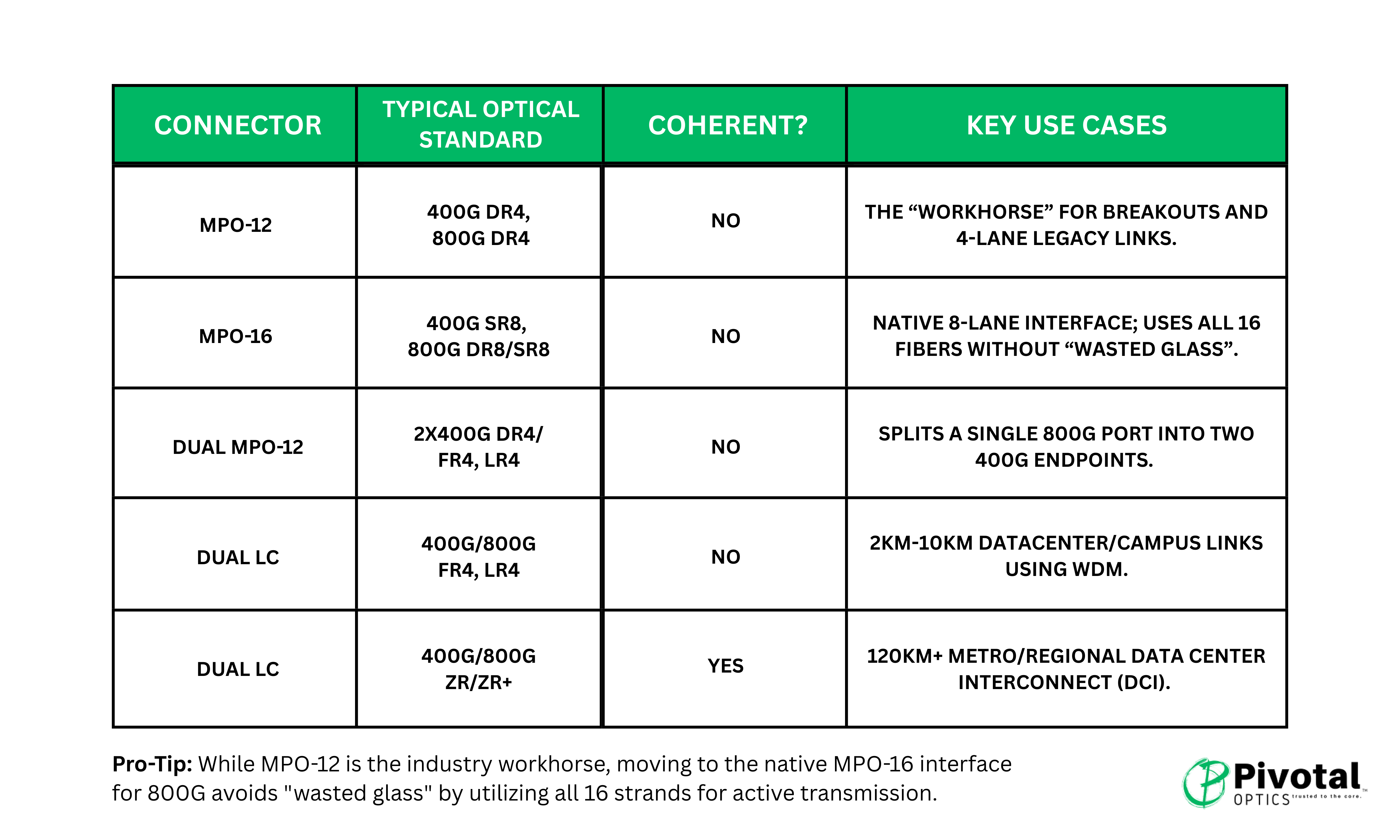
"The Strategic Split: AI Clusters vs. Service Provider Cores"
- Hyperscalers and AI (The OSFP Camp): These "Greenfield" environments prioritize the integrated heatsink of OSFP for maximum thermal headroom in massive, always on compute engines.
- Service Providers (The QSFP-DD Camp): The operational ease of backward compatibility plugging a new 400G module into an existing 100G slot far outweighs the marginal thermal gains of OSFP for bursty traffic profiles.
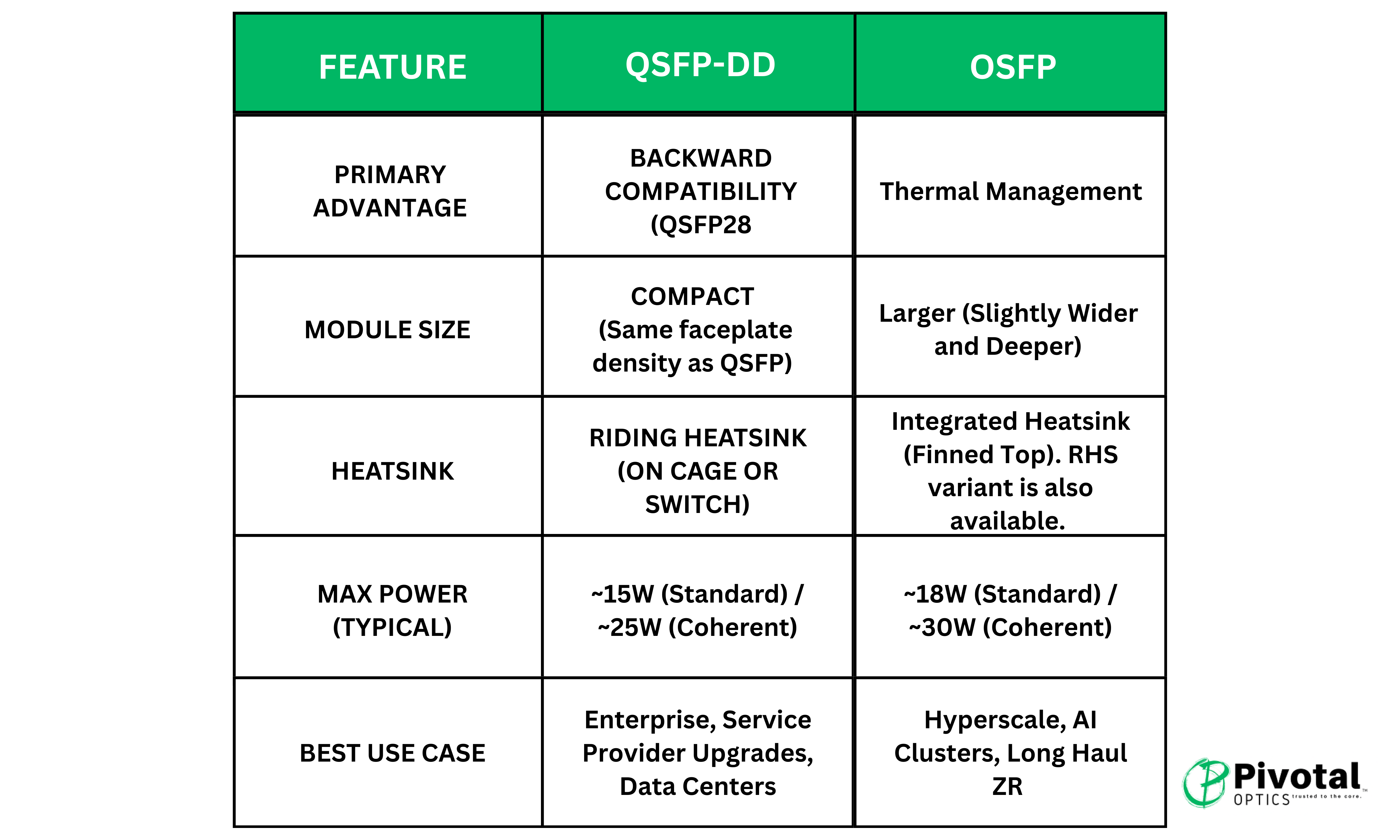
"Can you break down the specs side by side?"
For the engineers needing a quick reference, here is how the tradeoffs look on paper:
"How can Pivotal Optics help?"
We don’t pick sides; we ensure your choice works.
- Guaranteed Compatibility: We support both QSFP-DD and OSFP with precise coding and strict MSA adherence.
- Diverse Supply Chain: We leverage a global network to avoid the 50 week lead times common with OEMs.
- Technical Extension: Whether retrofitting a legacy headend or lighting up a greenfield 800G core, our team helps you navigate thermal, power, and connector complexities.
Contact one of our technical experts to walk through solutions that are right for you.