

The Unsung Heroes of the Optical Distribution Network: Solving the PON Migration Puzzle
Feb 25th 2026
In the evolution of Passive Optical Networks, or PON, the spotlight naturally falls on the stars of the show which is the active gear. The Optical Line Terminals and high speed transceivers represent the cutting edge of data rates and processing power.
However, the true strategic foundation of your network lies in the Optical Distribution Network. While active gear captures the headlines, the passive components, specifically Coexistence Modules (CEX), are the unsung heroes that enable a network to grow without a rip and replace disaster. CEX modules allow multiple generations of PON and other Optical Technologies to “Coexist” together on the same fiber.
Why Coexistence Modules? Solving the Migration Pain Points
Coexistence modules exist to resolve three primary challenges for network operators:
- Service Continuity: How do you upgrade to XGS PON or 50G PON without knocking your existing GPON customers offline? The CEX allows multiple generations of PON to share a single fiber simultaneously.
- Infrastructure Optimization: Laying new feeder fiber is the most expensive part of a build. The CEX multiplexes different wavelengths onto the same fiber so you can squeeze more value out of your existing glass.
- Capital Expenditure Agility: Operators can deploy next generation OLTs only when the demand exists, rather than performing a forced flash cut of the entire network.
The Physics of Coexistence: Why Quality Matters
CEX introduces optical tradeoffs that must be engineered, not assumed.
Any element inserted into the ODN affects power budget, isolation margin, and reflection performance. These impacts may be small in isolation, but in aggregate they define the operational stability of the network.
Optical Budget and Insertion Loss
Every passive component adds attenuation. In high split architectures (such as 1:32, 1:64, and beyond) the optical power budget is significantly reduced, meaning link margin is already tightly constrained. Because of these tight tolerances, the 0.6–1.2 dB of insertion loss from a CEX module must be meticulously accounted for to preserve reach and long term network stability
A high quality GPON/XGS coexistence filter typically introduces ~0.6–1.2 dB of insertion loss, with additional loss depending on integrated services such as RFoG overlay (1550 nm), OTDR (1625/1650 nm), or CWDM/DWDM overlay.
Carrier grade deployment requires full budget accounting (fiber attenuation, splitter loss, connector margin, and target PON class) to preserve reach and long term stability.
Isolation and Spectral Discipline
Coexistence depends on strict wavelength separation:
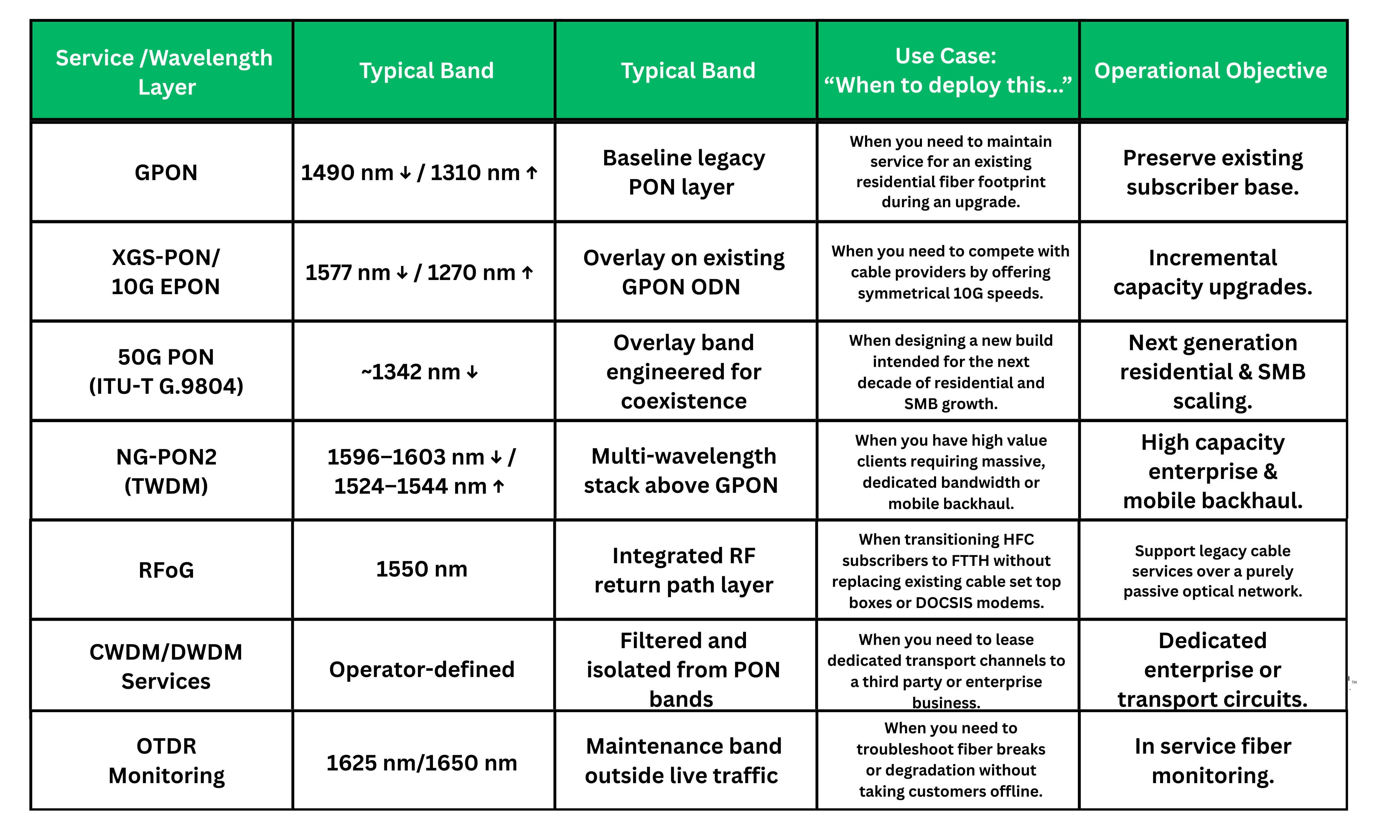
- GPON: 1490 nm / 1310 nm
- XGS-PON & 10G EPON: 1577 nm / 1270 nm
- 50G PON (ITU-T G.9804): ~1342 nm downstream
CEX modules should deliver ≥30–40 dB downstream to upstream isolation to prevent receiver desensitization and burst instability. Poor isolation often surfaces as intermittent sync issues or elevated BER in mixed generation deployments.
Reflectance and Optical Return Loss
As networks evolve toward XGS and 25G/50G PON, tolerance to optical impairments tightens. Excessive back reflections can increase noise floor and reduce dynamic range.
Carrier grade coexistence modules must maintain strong Optical Return Loss performance (typically >55 dB system level) to preserve stability across the full ODN lifecycle.
Coexistence is not just wavelength combining, it is optical margin management.
When engineered properly, it enables seamless migration. When overlooked, it quietly erodes performance headroom.
Getting Creative: The Versatility of Custom CEX Design
As a third party provider, our value lies in flexibility. We are not limited to standard off the shelf boxes. We can design bespoke wavelength managers that integrate a wide array of services into a single module.
While many providers focus solely on the ITU standards, Pivotal Optics provides full support for EPON and 10G EPON architectures.
We can design bespoke modules that integrate the following services regardless of your primary PON protocol:
The Bottom Line
The transition to XGS PON, 10G EPON, and eventually 50G is more than just a transceiver upgrade; it is a meticulously planned physical layer strategy. By utilizing high performance customized coexistence elements and intelligent splitter topologies, network operators can maximize their return on investment and navigate technical challenges without stranding their capital or their light.
No matter what route you go with your PON passives, whether you are looking for ultra low loss CEX modules, custom wavelength integration, or a rural specific tap strategy, Pivotal Optics are the experts here to help. We specialize in tailoring the ODN to your specific architectural needs, ensuring your network is ready for the stars of today and the heroes of tomorrow.