
How Pivotal Optics Delivers Real-World Optical Solutions
Posted by Pivotal Optics on May 22nd 2026
How Pivotal Optics Delivers Real-World Optical Solutions
Optical transceivers are often viewed as standardized plug and play components. Specifications are well defined, and interoperability is assumed. Deployment is expected to be straightforward.
In practice, the reality is far more complex. Variations in firmware implementation, host platform behavior, and manufacturer quality control introduce challenges that are not visible on a datasheet but have a direct impact on network performance.
At Pivotal, our engineering process is not just about moving hardware. As a Strategic Optics Partner, we bridge the gap between manufacturer capabilities and the specific constraints of your network.
In this article, we walk through how Pivotal approaches engineering from initial concept through validation and deployment. We also highlight the often-overlooked challenges that impact real world performance.
Where Engineering Begins
Before any design work begins, we focus on a fundamental question: what should we build next, and why?
At Pivotal, engineering priorities are shaped by a combination of customer demand, field feedback, and forward-looking visibility into where the broader Network Equipment Manufacturers (NEM) ecosystem is heading. No single input drives the roadmap on its own.
In practice, decisions are guided by three key factors:
Customer driven requirements: Direct requests define immediate needs such as compatibility targets, reach requirements, or deployment constraints. These inputs ensure we are solving real problems in real environments.
Ecosystem direction: We continuously evaluate where major NEM ecosystems are investing in terms of bandwidth scaling, architecture evolution, and interoperability requirements. This helps guide long term engineering focus so that solutions remain aligned with industry direction.
Feasibility and scalability: Not every request becomes a product. We evaluate whether components can be sourced reliably, whether performance can be validated consistently, and whether a solution can scale beyond a single deployment.
Only when these three factors are aligned do we move into active engineering.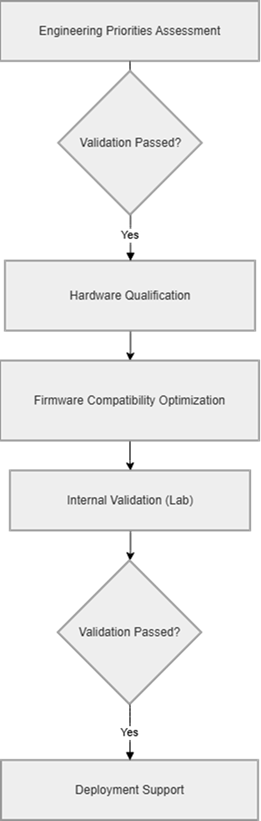
Navigating the Manufacturer Ecosystem
The optical supply chain has grown to include more than 100 manufacturers. However, quality is not uniform across that ecosystem.
Our process begins with a structured Path to Hardware Approval.
Tier One Relationships: We maintain close working relationships with manufacturers that are also trusted by major NEM ecosystems. This ensures access to production ready components that meet strict industry expectations.
Continuous Manufacturer Validation: Qualification is not a one-time step. Even after a manufacturer is approved, we continue to test production batches to confirm they match the performance of validated samples.
Independent Verification: We do not rely on vendor claims alone. Our engineers review datasheets and Design Validation Test reports, then independently validate performance against MSA and IEEE standards. If a manufacturer specifies receiver sensitivity, we verify it in our lab.
Customizing Firmware and EEPROM
A common misconception is that optical behavior is defined by a single layer of code. In reality, we validate and optimize two distinct layers.
Firmware: This is the internal operating system managed by the manufacturer. We work directly with vendors to ensure firmware behavior aligns with interoperability and performance requirements.
EEPROM: This defines how the host system identifies and communicates with the optic. Through internal compatibility coding, we configure EEPROM structures so that optics are recognized correctly across multiple platforms and remain aligned with MSA expectations.
Many large network equipment manufacturers design optics specifically for their own ecosystems. Cross platform compatibility is not always a priority. Pivotal takes a different approach. Every optic is validated across a broad range of host platforms to ensure consistent behavior and to avoid compatibility issues in third party environments.
What “Done” Really Means in the Lab
A product is only considered complete after it has passed internal validation under conditions that simulate real network environments.
Our testing includes several key areas.
Environmental and Boot Stability: We test link initialization and recovery after fiber disconnects as well as hard and soft reboots. The goal is consistent startup behavior in all conditions.
Optical Precision: Using spectral analysis tools, we validate transmitter power, wavelength accuracy, and receiver tolerance limits. This includes overload and sensitivity testing.
Long Term Reliability: We run extended traffic tests at full throughput over maximum link distances. We also perform dispersion and attenuation stress testing while monitoring bit error rate performance.
Digital Diagnostics Monitoring Accuracy: We verify that telemetry values such as temperature, voltage, and laser bias reflect accurate operating conditions and respond correctly to threshold limits.
From Lab to Live Network
Even extensive lab testing cannot replicate every deployment scenario found in the field.
In live environments, we often work directly with customers to understand system behavior and deployment requirements. One of the most effective approaches is establishing a known good baseline. This means first validating the system using original NEM optics and then introducing third party optics.
This method helps isolate variables, reduces ambiguity, and ensures that performance issues are correctly identified rather than misattributed.
Closing the Gap Between Spec and Reality
The value of an optics partner is not defined by a part number. It is defined by the engineering effort required to understand where standards diverge and how to maintain consistent performance despite those gaps.
Engineering optical solutions is ultimately about bridging the distance between a datasheet and the real world.
By partnering with Pivotal Optics, customers gain access to a dedicated engineering extension of their team that focuses on validation, interoperability, and long-term network reliability.