Beyond the Transceiver
Posted by Pivotal Optics on May 6th 2026
Scaling Education: How Pivotal Built a Resilient 100G Optical Ring for a School District
In modern education, the network is just as critical as the classroom. As student devices, digital learning platforms, and administrative systems continue to grow, many school districts are finding that traditional fiber architectures cannot keep up.
We recently partnered with a fast-growing school district to redesign their core transport layer, transforming a rigid point to point network into a resilient, high-capacity optical ring.
The Challenge: Breaking the Bottleneck
The district’s existing infrastructure relied on traditional "grey" optics. These standard 100G LR connections required a dedicated fiber pair for every link.
As the district expanded, this model created two fundamental constraints:
- Fiber Scarcity
Every new high-speed circuit required additional physical fiber. This increased costs and slowed deployment timelines. - The "Active Hop" Risk
Traffic often passed through multiple intermediate switches. A failure at a single campus, such as a powered down middle school, could disrupt connectivity for downstream sites like the high school.
This was not just a scaling problem. It was a resiliency problem.
The Solution: A Passive DWDM Optical Ring
Instead of continuing to scale a legacy architecture, we helped the district rethink their transport layer.
By introducing a passive DWDM ring architecture, we enabled both resiliency and significant capacity gains without requiring new fiber builds.
Key elements of the design included:
- Eliminating Active Dependencies
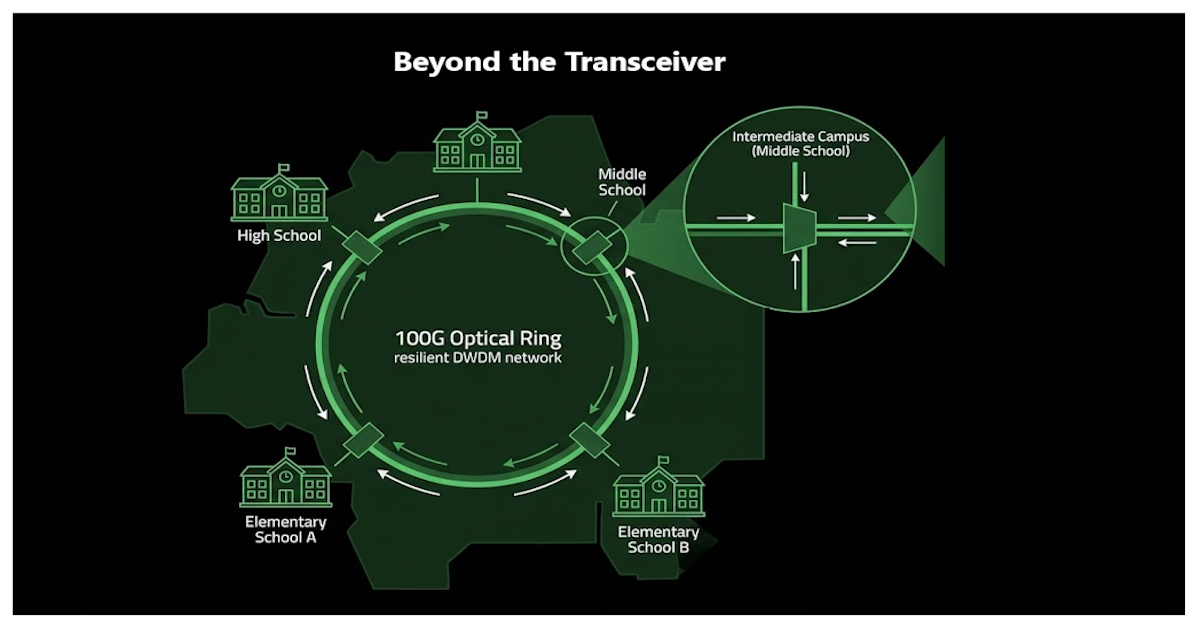
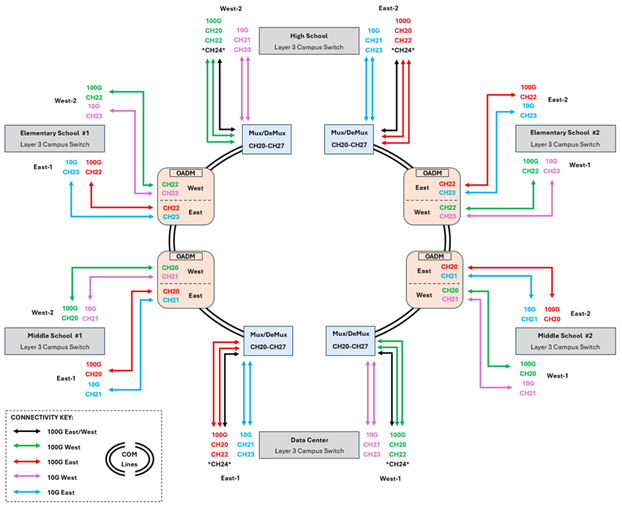
We deployed Optical Add Drop Multiplexers at intermediate campuses. These allowed specific wavelengths to pass through sites at the optical layer without interacting with the switch.
The result is simple. The high school’s 100G circuit no longer depends on any intermediate campus being online. Its wavelength remains uninterrupted, even during outages.
- Creating Virtual Fiber with DWDM
Using DWDM channels from 20 through 27, we multiplexed multiple 100G and 10G services onto a single fiber pair.
This transformed one fiber pair into a multi lane highway that supports parallel, isolated services without additional construction.
- Ring Based Path Diversity
The design uses bidirectional paths across the ring. Traffic can reroute in the event of a fiber cut, adding another layer of resiliency compared to traditional linear designs. - Multi-Vendor Interoperability
The district’s environment included a mix of switching platforms. We used QSFP28 DCO tunable DWDM optics that were coded to align with each network equipment manufacturer, ensuring seamless compatibility across the deployed infrastructure.
The Impact
By partnering with Pivotal Optics, the district achieved:
- A resilient transport layer with no single point of failure at intermediate campuses
- Increased bandwidth capacity without adding fiber
- Faster scalability for future campus growth
- Full control over a private, high performance optical network
Most importantly, they separated network growth from physical infrastructure constraints.
Each campus now has its own dedicated "swim lane" of bandwidth, ready to support the next generation of digital learning.
The Pivotal Partnership
Achieving these results required more than just hardware; it required a strategic approach to the topology. Pivotal’s role extended beyond supplying hardware.
We worked closely with the district to:
- Design the full DWDM topology and channel plan
- Map OADM placement and wavelength routing
- Provide clear visualizations of bypass paths and ring behavior
- Deliver a practical deployment roadmap for their internal teams
Ready to see the difference Pivotal Optics can make for you? Contact our sales department sales@pivotaloptics.com.