Posted by Pivotal Optics on May 6th 2026
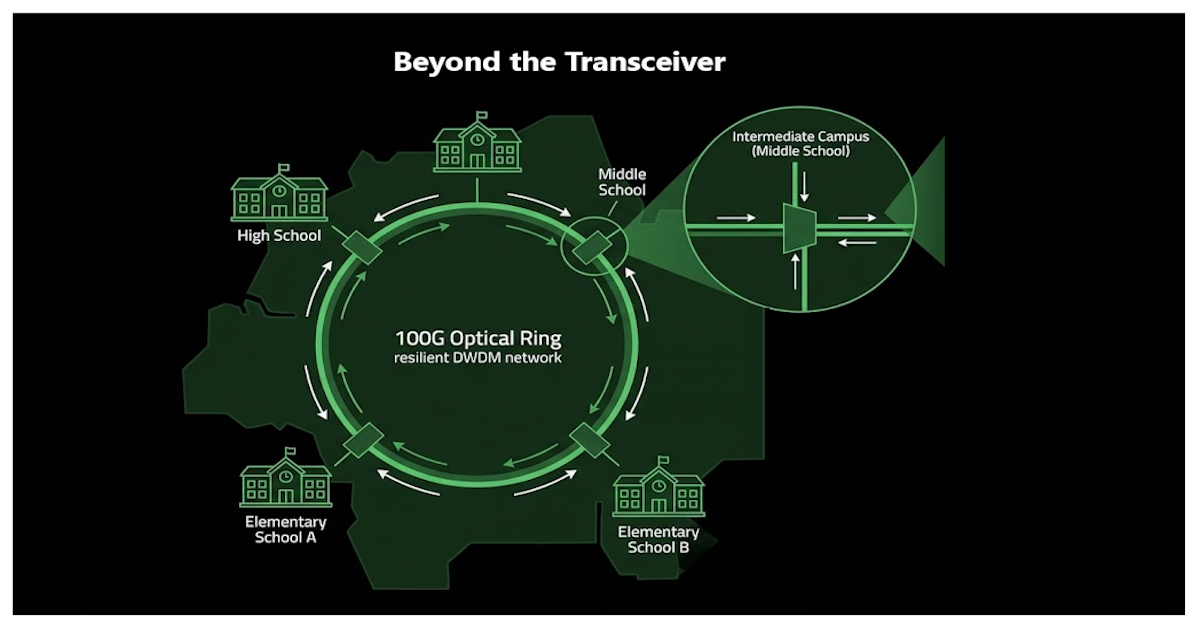
Scaling Education: How Pivotal Built a Resilient 100G Optical Ring for a School District
In modern education, the network is just as critical as the classroom. As student devices, digital learning platforms, and administrative systems continue to grow, many school districts are finding that traditional fiber architectures cannot keep up.
We recently partnered with a fast-growing school district to redesign their core transport layer, transforming… Read more
Filling the Market Gap: The Case for a Native 1G Tunable SFP
One of the first lessons in any MBA curriculum is that the best product is the one that fills a genuine market gap. At Pivotal Optics, that is the exact approach we took with our Native 1G Tunable SFP offering.
For years, 1G DWDM operators have managed a difficult balancing act between two operational models. On one hand, you have the logistics of managing 40+ fixed-wavelength SKUs. On… Read more
When a network fails on turn up, the first instinct is to look for something complex:
Configuration. Compatibility. Firmware. Something deep in the stack.
But sometimes, the problem is much simpler and much more uncomfortable:
Sometimes, the product you deployed isn’t the product you tested.
A scenario we’ve seen play out in the field should sound familiar to anyone who’s spent time in this industry. Teams do everything right. T… Read more
Posted by Pivotal Optics on Mar 27th 2026
NEM vs Third Party Optical Transceivers: Cost, Performance, and Supply Chain Strategy
Anyone reading this has likely heard the NEM vs third party optics debate. It has circulated in the industry for years, and by now the question is no longer whether third party transceivers work. Operators already know they do.
However, the conversation is gaining renewed attention as networks adopt 400G and higher data rate optics. The increasing complexity of… Read more